
PETROLEUM VALUE CHAIN OPTIMISATION IN NIGERA: UNDERSTANDING THE DRIVERS AND INTENTIONAL AND STRATEGIC PROVISIONS IN PIA 2021
THE STATE OF THE PETROLEUM INDUSTRY IN NIGERIA: MATTER ARISING FOR THE ATTENTION OF THE PRESIDENT OF THE FEDERAL REPUBLIC OF NIGERIA
By Omowumi O. Iledare, PhD, Professor Emeritus, LSU Energy Studies, USA, GNPC Petroleum Commerce Chair, UCC Institute for Oil and Gas Studies, GH, and Executive Director, Emmanuel Egbogah Foundation, Abuja, NG.
Preamble
The potential for Nigeria as a key player in the global economic landscape was incredible in the 1970s with great determination to use its enormous petroleum rent for infrastructure development, enhance training and human capacity development, and establish linkages across its economic sectors. However, the dreadful side of petroleum endowments began to raise its brow in the 1980s as petroleum rent seeking and rent sharing crowded out sound economic judgement, while political expediency began to trump efficiency and effectiveness in decision making. The strategy to optimize the entire petroleum industry value chain for sustainable national development and posterity became secondary to personal prosperity ambitions of the elites, to a large extent, because excess cash from a huge petroleum rent when the price of oil quadrupled. The appetite for luxurious living observable in the “JR Dallas Show” restrict keeping posterity in view while making decisions. The adjustment to the first ever crude oil price collapse in the mid-1980s and the promised nation is yet to be fully realized. The purpose of this op-ed is to facilitate better understanding of the petroleum value chain and offer a strategic optimization approach to making the oil and gas industry great again, the major driver of the transformation of the economic structure of Nigeria in the 1970s. There are plausible reasons to believe that if an integrated approach to petroleum development can be adopted going forward, the contribution to GDP from the oil and gas industry could be back to the 25-30 % range experienced in the 1970s.
Petroleum Industry Value Chain:
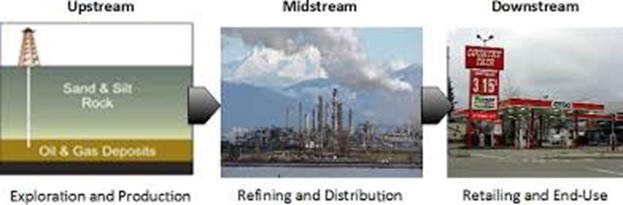
Chart 1 provides a pictorial view of the petroleum industry value chain, which reflects the independent, economically valuable segments of the oil and gas industry. The three specific activities of the oil and gas industry, which creates value are the upstream, midstream, and downstream. Upstream begins with leasing activities and the downstream end products are sold to consumers. Each of the segments can be performed by standalone firm and profitability varies from segment to segment.
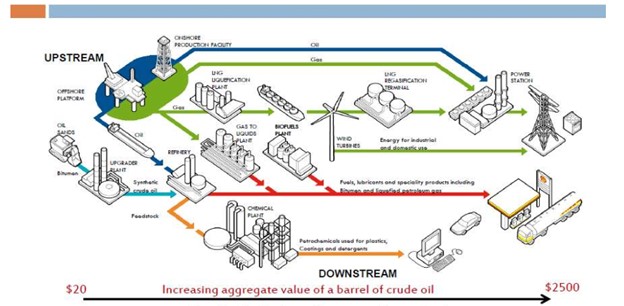
Chart 1: Petroleum Value Chain is Complex, Rich and Highly Profitable
Upstream — Activities and businesses in this segment of the value chain involve exploration, development, and production of crude oil and/or natural gas. The segment is the riskiest in the value chain, however, with potential for huge rewards. The most profitable indeed. Oil and gas are discovered during exploration after a lease is obtained and usually, exploration takes place where resources are located. Discoveries is followed by development and production comes after infrastructures are installed. Bidding process for leases varies from country to country, but it has been established that the discretionary award of oil and gas block is inefficient and does not optimize the fair market value of petroleum endowments. Thus, PIA 2021 disavows discretionary blocks of petroleum leases as an optimization strategy and one can only expect that the related provisions in the law are sacrosanct.
There are two broad arrangement categories to facilitate upstream business operations for petroleum value optimization—concessionary and contractual arrangements. Most upstream activities and businesses worldwide are based on some form of partnership to share risk and rewards. However, funding upstream petroleum assets in developing economies, with a significant presence of National Petroleum Companies, have become riddled with great challenges with significant cost of capital. Perhaps, because the easier to find petroleum assets have diminished even as finding and development cost is trending upward, the propensity to adopt a contractual agreement in the deep offshore terrain seems much more fashionable than modern concessionary arrangements, which remains dominant in the shallow water and land terrains in Nigeria.
Thus, regarding upstream value optimization from the perspectives of either the host government or operators and partners in Nigeria, the preferred arrangement between concessionary and contractual, especially the production sharing arrangements, is conjectural and highly dependent on the petroleum fiscal design, terrains, assets threshold, and institutional governance. The PIA 2021 recognized these drivers of petroleum value optimization, especially in the upstream segment. The Act offered a progressive, flexible, effective, and to a large extent, a very robust fiscal framework, which deemphasizes early revenue extraction access to the federation account from petroleum extraction in Nigeria. The implications of less access to early revenue on the federation account might be significant and, in the process, have negative impact on budget implementations. Time will tell.
Further, because the major assets for upstream firms are proved reserves, it is imperative to open up more basins for exploration activities in a more regular fashion. That the last bidding round for oil and gas leases in a prolific petroleum province like Nigeria, is 2007, leaves much to be desired. Interestingly, in the emerging PIA era, role separation of industry institutions and well-articulated functions and responsibilities of these institutions have removed the amorphous regulatory space and reduce significantly political uncertainty limiting investment flow into Nigeria. An important hallmark of the PIA is recognizing the fact that asset profitability in the upstream is affected mostly by costs and commonly price and costs are volatile. The Act introduces a cost efficiency ratio as an incentive to minimize the rate of cost escalation or gold plating of cost. In addition, the Act made its royalty design progressive within a terrain, allowed taxes to be consolidated across terrains, especially the resource tax.
Midstream — The activities and businesses in this segment of the value chain are transportation, aggregation, storage of products and crude, natural gas gathering and processing, marine shipping, and transportation. In the Nigeria space, this segment of the value chain is still evolving. Yet, it is extremely critical in the petroleum value chain optimization goal. This is particularly more so in the energy transition race towards renewables and as integrated petroleum development for domestic market becomes more viable than the offshore markets. Additionally, for the domestic and international markets a viable midstream segment of the oil and gas industry in Nigeria is a necessary requirement to the global low carbon emissions goal. Moving petroleum products by road across several geopolitical zone seems ineffective, inefficient, and inequitable to add value in a complete sense. It is environmentally difficult in the carbon emissions race challenge.
The global acceptability of natural gas as a transition fuel is an enabler for the expansion of midstream of the gas value chain in Nigeria. In fact, PIA 2021 makes the “Decade of Gas Mantra” of the administration of President Buhari meaningful. In its fiscal framework, PIA 2021 has lower royalty for gas development than for crude oil. The Act imposed no resource tax on gas development and lowered rent extraction by royalty for domestic gas by 50% of royalty rate imposed on natural gas for the international market. The PIA also created a midstream funding to facilitate partnerships in domestic gas pipeline investments for gas infrastructure.
An important component of the midstream in the value chain optimization aim is crude oil trading and marketing. It is curial in the race to optimize the petroleum value chain in Nigeria. Crude oil is sold and transported from the wellhead to a refinery. Crude has no value unless it is refined. The movement of crude is essential to its final value, and transportability of crude oil is its biggest advantage over natural gas. The major setback for crude movement is illegal bunkering and terrorism and sabotage. There are three types of transactions for the sale of crude oil– Spot transactions, futures markets, and contract arrangements. In the spot market crude is sold for cash and immediate delivery. A spot market for crude and gas cannot develop if immediate delivery is impossible. So, the key phrase is immediate delivery. Spot market prices send definitive signal about the current balance between supply and demand.
Downstream — The downstream value chain consists of activities and businesses involved in processing and refining oil and gas and the distribution, marketing, and packaging of petroleum products to industrial, commercial, residential, and utility and power generation end-users. The refining process is critical to the petroleum value chain. Crude oil has no final value until it is transformed into petroleum products such as gasoline, diesel, heating oil, propane, asphalt, and petrochemical inputs depending on the complexity of refinery infrastructure. No two refineries will achieve the same margin for a given crude or the same mix of refined products. Refinery mix products is driven by refinery complexity in terms of the ability to process crude feedstocks and determine its product mix and added value.
Refinery complexity, location, and product demand affect refinery margins and profitability. The process is capital intensive and anything impacting allocation or availability of capital will affect profit. Importantly, crude oil is the primary feed stock, and its price is determined in the world oil market with the high impact on variable costs. Other variable cost items are within the control of the refiner—utilities, labor but regulatory and fiscal costs affect the bottom line as well as. Most of the refinery products are traded as commodities and pricing of products is key to refinery value chain optimization. Additionally, technological, and managerial capabilities are also critical to run and efficient and profitable refinery being a manufacturing industry.
Technology and refining innovations can improve productivity at a lower cost and product quality. Environmental mandates especially for motor fuels has impact on refinery margin. Capacity utilization as in all manufacturing industries affects profitability. The optimum utilization rate in the US is 90-95% and anything below 90% there is a loss in economies of scale and higher costs. The challenge in Nigeria is obvious with as low as 10% capacity utilization over many decades thereby significantly eroding the optimal equity oil value over the years in an aggregate sense. Measuring value using gross revenue access is misleading as evident by the significant contribution of oil and gas to Nigeria budget in comparison to less than 10 percent contribution of the sector to the gross domestic product (GDP) of Nigeria.
Thus, optimization of the petroleum value chain has been badly limited because of the midstream and downstream dysfunctionality and market failures as also observed in Nigeria’s power sector. A compromised, inefficient, and ineffective energy end-use market structure restricts optimality in the aggregate energy value chain. PIA 2021 offers a pragmatic solution with a transparent and accountable licensure of private refineries to business savvy and technically sound investors who understand that expectation without effort is the mother of entitlement.
Marketing refinery products is highly politicized worldwide, especially the motor fuels. This is particularly so common in petroleum dependent economies like Nigeria. Labour unions in Nigeria seem to hold the sway to limit pricing of petroleum anywhere close to the market clearing price with preference for price ceiling. The consequences of the latter are the perennial shortages of the motor fuels every so often for years. Additionally, price ceiling often leads to black market high prices significant welfare losses, huge subsidy payments. In fact, pricing petroleum below the market clearing price has also placed a lot of burden on forex making exchange rate highly volatile.
PIA 2021 made attempt to limit the anti-competitive market structure of the motor fuel retail market in Nigeria. It scrapped the Petroleum Price Regulatory Authority (PPPRA). Further, the Act disbanded the Petroleum Equalization Fund and the fact that the provisions Petroleum Act 1969, which empowered the Minister of Petroleum Resources to set petroleum product prices have been rendered ineffectual. Additionally, the Petroleum Authority tasked with regulating the midstream and downstream petroleum value chain has no authority to fix petroleum product prices in the PIA 2021.
Unfortunately, the prevailing money market disequilibrium with higher demand for forex than supply has literally made the PIA commercial institution a single importer of motor fuels driven mostly by energy supply security but with a significant cost to the federation account in my opinion. For example, it has been recently alleged that by June 2023, N10.6 trillion would have been spent over 18 months! Subsidy payments an act of lawlessness as PIA 2021 became the petroleum law in August 2021. The Act was intentionally crafted to eliminate the glaring anti-competitive conduct in the petroleum downstream markets.
Certainly, removing subsidies can be politically burdensome even though it is glaringly unsustainable. But the Law calls for it and doing anything else sends a wrong signal. However, removing subsidy is not going to make the economy worse than it is now or even if it had been removed in 2015. Removing subsidy will more likely than not rekindle Nigeria economy and perhaps lessen the pressure it imposed on the forex market and perhaps limit young Nigerian from taking the “japa” option to the Diaspora. While in the short run the price of motor fuels might rise but it will stabilize in the not distant future. The removal would be just a temporary shock with a short adjustment process subject to foreign exchange stability and Dangote refinery becoming operation as scheduled.
As I mentioned in my op-ed of May 2021, crowding out investors from capital fund inhibits growth and money supply chasing fewer goods create skyrocketed inflation, which is cancerous to the economy. Inflation in Nigeria has skyrocketed since then and debt-funded subsidy payments have more than doubles. Countries like the United States and Venezuela, which for many years controlled the price of petroleum products offer great lesson for Nigeria not to continue along this path. It is like riding on the back of the tiger. It is an economic suicide. PIA intentionally wanted subsidy to end in the retail market, making it illegal. Just do it, the economy will be better off.
Concluding remarks
That the endowment of petroleum resources in a nation, region or province has great potential to accelerate economic development is not conjectural. Also very plausible is expansive government access to a huge economic rent and surplus petroleum revenue. Unfortunately, empirical evidence suggests that, if not properly managed, the expansive petroleum revenue in government cover can be detrimental to sustainable national development and economic growth in such a petroleum producing province. Nigeria’s experience offers a classic example for the two plausible likelihoods and petroleum discovery literarily changed the economic and governance structure of Nigeria since the 1970s.
The emerging energy transition era makes it imperative for Nigeria to move away from crude oil and natural gas for revenue transactional mindset to crude oil and natural gas for value creation and national income expansion with a transformational mindset. The petroleum industry value chain is complex, rich, and expansive with inherent challenges that requires intentional compliance to the PIA 2021 provisions to optimize the petroleum value chain. Regrettably, however, the Act, in my opinion, abandoned fiscal rules of general application in selectively applying the dual tax system and its royalty schemes in favor of the deepwater terrains, when compared to shallow water and onshore assets.
An important component of the midstream in the value chain optimization aim is crude oil trading and marketing. It is mindboggling to trade Nigeria crude via swapping and/or through trade by barter in the presence of several marketing options. Additionally, crude oil price volatility and transaction costs, make it more likely than not, that collecting royalty payment and petroleum rent taxes in-kind rather than in cash limit the optimal value of petroleum value chain in Nigeria.
The refining process is critical to the petroleum value chain. In the emerging PIA era, a dominant refinery is about to enter the Nigeria refinery space with approximately 650 K barrel per day refinery throughput. The Dangote refinery throughput will account for more than 50 percent of the total available throughput in the West Africa Refinery space with more than 90 percent utilization rate. Understandably the Dangote refinery is located inside the free trade zone but would have implications on the downstream market in Nigeria and not only because of the 20% equity share NNPC Limited has as a partner but also market fundamentals, which include locations as a key factor affecting refinery profitability.
Marketing refinery products is highly politicized worldwide, especially the motor fuels, more so in petroleum dependent economies like Nigeria. Labor unions in Nigeria seem to be averse to pricing of petroleum products at the market clearing price with a preference for price ceiling. The consequence of the latter is the perennial shortages of the motor fuels every so often for years and huge petroleum subsidy payments, allegedly approximated at 11.2 Trillion Naira over the last 18 months. Subsidy payments an act of lawlessness as PIA 2021 became the petroleum law in August 2021. The Act was intentionally crafted to eliminate the glaring anti-competitive conduct in the petroleum downstream markets to do things right and in the right way, a necessary condition to optimize petroleum value chain for sustainable economic growth and development in Nigeria.
Finally, let me repeat what I have suggested severally that the PIA 2021 is not a perfect law, but it is a workable law despite its limitations. The apparent limitations in the Act are amendable over time. Two of such limitations are, the provisions for gas development and deep offshore assets are significantly enviable in comparison to fiscal terms and instruments for onshore crude oil leases owned by indigenous oil and gas operators. Of course, NASS is expected to revisit the fiscal framework after two years.
Source: The ValueChain