
QUESTIONS & ANSWER ON TRIPLE HELIX MODEL APPLICATION: A PRELUDE FOR INNOVATIONS IN THE ENERGY INDUSTRY
QUESTIONS & ANSWER ON TRIPLE HELIX MODEL APPLICATION: A PRELUDE FOR INNOVATIONS IN THE ENERGY INDUSTRY
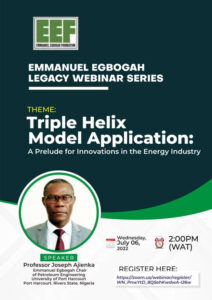
Professor Joseph Ajienka, Emmanuel Egbogah Chair in Petroleum Engineering, UNIPORT
Q: World Bank and the International Finance Corporation are about providing technical and financial support to the Nigerian Government for CO2 storage in a saline aquifer. How do universities in Nigeria co-opt the government and industry in championing this instead of playing second fiddle to foreign experts?
A: CO2 Storage in saline water is a proven process born out of research. Petroleum Engineers have for many years known about gas reinjection and storage in depleted reservoirs. We also know about carbon capture and storage. And so, one expects or assumes that behind this project are researchers from our universities. Otherwise, it would be the silo mentality of developing countries that characterize the state model I talked about in the presentation. Universities in Nigeria are being enlightened about the Triple Helix Model, the National Universities Commission is also becoming more aware. One hopes we can all work together with industry to develop our country.
Q: Prof Ajienka Sir could you please initiate Triple Helix Plus units in every department at the university for a broader outreach?
A: I have been making some effort to create awareness within the university. The IPS model which practiced the Triple Helix Model has been adopted by some institutes and centres with very visible benefits. I had in a seminar at the Music Department demonstrated a template for implementing it in the Music Department, which can be adapted for other Departments. It is my hope that it will gradually take root and lecturers will voluntarily adopt it at departmental level. The DVC R & D and some senior members of Staff attended the Webinar. If it is so decided by Management, we can work at it for implementation.
Q: The world is transitioning and shifting towards electric vehicles, and refineries are adapting from crude oil refining to chemicals. Is Nigeria thinking and planning for this?
A: I hope so. We need to position ourselves to take advantage of the wave of energy transition to develop electric cars and other sources of zero carbon fuels. Already, some developments with solar and electric cars have been reported. Many have argued that for developing economies like Nigeria, we must adopt just energy transition, in a well-considered manner to ensure we derive maximum benefit from our hydrocarbon reserves well watch the speed of transition.
Q: Prof, Triple Helix is phenomenal, but how we domesticate it in Nigeria – Making it Policy Framework for the Government?
A: Domesticating Triple Helix is through well-articulated and steadfast enlightenment of policy makers in Government, leaders of higher education institutions and CEOs of industry is possible and is the way to go. When we are convinced of the benefits it will take firm root. The Emmanuel Egbogah Foundation hopes to issue policy White Papers of these Webinars to encourage adoption and implementation.
Q: Who are those requiring a changed mindset and how do we change bring about a changed mind set?
A: The change of mindset is expected from all partners in the Triple Helix Model- technocrats of Government, academics in our university system and industry experts. WE all need to realize that the new way of doing things is much better, proven, more realistic and result orientated. We cannot continue to do the same thing and expect different and better results as Einstein advised.
Q: What is the barrier to sustainability and enabling environment? We have some of the best brains globally but the enabling sustainable environment is not there to deal with peculiar Nigeria specific issues! We need to be addressing the roadmap for this more.
A: The barriers to sustainable development lie in us. That is why a change of mindset is advocated. This change will come from convinced knowledge that the new way is better. We cannot continue to suffer in the midst of all the talents and natural resource endowments. The major barrier is lack of transformational leadership that is committed and selfless. The followership that picks crumbs that are used as baits for electioneering, handouts that fell from the table of the privileged politicians should also change their mindset. Infrastructural development is first of mental before physical let alone what they have now called stomach infrastructure because of poverty of mind and intellect. Everyone needs this change of mindset through proper enlightenment of the consequences of the forsaken path we are following that leads down the slippery slope into the abyss of collapse. Indeed, it is very frustrating, but we must keep hope alive and continue to make the effort at enlightenment.
Q: How do we in Academia facilitate this sustainability like the actors that done?
A: Like one of the participants remarked, the major actors and producers in the creative industry were products of academia. Pioneers of the creative industry like Hubert Ogunde did not have access to the technology then. But when the time was ripe, the Nollywood creative industry was born and blossomed even without direct Government support. It took root through the determination of graduates of theatre arts seizing the opportunity of video technology to produce videos for entertainment. They wrote the scripts and acted, supported and funded by businessmen and women who invested to make profit. And so gradually, the improved on the quality of scripts and film production. If only university and industry could collaborate for innovation and commercialization. We are beginning to see signs through startups from digital technology innovations and platforms.