
THE 2023 ENERGY INSTITUTE (EI) STATISTCAL REVIEW OF WORLD ENERGY: PRIMARY ENERGY PANORAMA IN AFRICA
THE 2023 ENERGY INSTITUTE (EI) STATISTCAL REVIEW OF WORLD ENERGY: PRIMARY ENERGY PANORAMA IN AFRICA

By Omowunmi Iledare, Ph.D., Snr. Fellow USAEE, Fellow NAEE, Fellow EI, Fellow NIPetE, Professor Emeritus in Petroleum Economics and Executive Director, Emmanuel Egbogah Foundation, Abuja, NG
Preamble
The 72nd Edition of Statistical Review of World Energy marks a new dawn as the management and proprietorship of the periodical shifts to the Energy Institute UK (EI) from the inaugural publisher, the British Petroleum (BP). The magazine is unique because it has been made available over the last seven decades at no out-of-pocket cost to users. So delighted to note that EI is seemingly committed to the free access philosophy of BP. For many years, the Statistical Review has uninterruptedly provided data and information on primary energy resources, reserves, production and energy consumption and carbon emissions by region, country, and the end-use sector. Energy analysts in government, industry and academia have used this data and information for informed energy and environment policy planning, regulatory effectiveness guidelines, and investment performance analysis. Of course, it is not conjectural that the quality of information reported in the publication is highly dependent on the sources of the information, which perhaps makes information on energy in Africa, to some extent in comparison to other regions, very bare. The information dearth on energy in Africa, especially West Africa, notwithstanding, the aim of this op-ed is to offer a viewpoint on energy in Africa within the context of the emerging energy landscape arguably reflected in the 2023 EI Statistical Review on World Energy.
STATISTICAL REVIEW OF WORLD ENERGY— OVERVIEW
According to EI (2023), the global energy landscape in 2022 was tumultuously stochastic in three dimensions—global energy supply security, rickety global macroeconomic performance because of rising energy prices, and environmental predicament with respect to global warming. Rising energy prices largely hindered global economic recovery from COVID 19 with evidence of rising inflationary trends worldwide. The glamour for transitioning from fossil energy systems grew even louder in 2022 as the average global temperature stood at about 1.150C above the pre-industrial level. The devastating floods in Pakistan, which affect millions in addition to increasing frequency of heat events across Europe and North America did set the climate crisis alarm louder in 2022 accordingly (EI, 2023).
The EI statistical review shows that “the post-COVID bounce back in terms of the growing demand for transport fuels seems to be at a slower pace than it was in 2021 with significant variations in trends among regions and across fuel types. Further, EI (2023) submits that “the Russia-Ukraine conflict, brought back into the radar, the vulnerability of energy security and affordability dilemma with an unprecedented shift in trade flows of natural gas, oil, and coal.” The consequences seem to be evident in the unprecedented change in global energy trade flows, especially in the international market terrain.
Additionally, there is empirical evidence to suggest that the pace at which renewable energy is deployed continued to expand globally. The expansion, however, is more pronounced in the non-OECD countries reporting 25 % growth in solar and 14% growth in wind, particularly, in China and India, with nearly 20% growth in renewable power generation (EI, 2023). Perhaps the worldwide growth in renewables is attributable to advances in solar and wind technology, which makes adaptability and accessibility of these resources affordable, subsequently, contributing about 84% of the net additions to the power sector.
Notwithstanding the fact that consumption of worldwide renewable energy reached the highest share ever in 2022, the overall growth of global primary energy consumption was only 1% and the dominance of fossil fuels in the energy mix barely dented at 82%. The increases in coal and oil consumption, more than offset the declines in gas consumption. Consequently, EI (2023) inferred that the benefits carbon emissions reduction from increasing renewable energy was partially offset by the undented proportion of fossil fuels in the energy supply mix. The growth of carbon emissions in 2022 was at about two-thirds the rate of energy growth at 0.8%, which makes absolute energy related emissions out of sync with Paris Agreement expectations (EI, 2023).
ENERGY AND ENERGY RESOURCES IN AFRICA
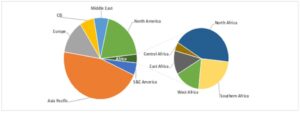
Primary energy consumption in Africa accounts for just 3.4 percent of the total world primary energy consumption in 2022 (See Chart 1). Or on the other hand, the population of the Continent is equivalent to about 17.9 of the total world population. This seeming inequitable is certainly driving the call a just energy transition as the energy landscape evolves around renewables. Primary energy consumption growth in Africa, on average, is estimated at 1.9% per annum over the last ten years in comparison to global annual demand growth of 1.4%.
Energy Institute Statistical Review of World Energy 2023
However, in the more recent year, the global growth in energy demand is estimated as 1.1 % compared to the 0.3 percent growth in Africa. Energy is the engine that drives global economies. While energy production is pronounced at creating elites in the society, energy consumption is critical for aggregate national quality of life enhancement, and productive sector expansion for sustainable economic growth. It is an established fact that energy consumption per capital and GDP per capital are highly correlated.
It is not conjectural to say that Africa, especially, West Africa, is energy poor, perhaps, not for lack of resources but because of low accessibility, availability and adaptability of secondry energy—electricity and petroleum products in particular. Per capita energy comsunption in Africa in 2022 was 14.2 GJ. This is about a quarter or a tenth of the per capita energy consumption in South and Central America or Middle East, respectively, in 2022. Whilst the global average per capital energy consumption grew annually at 0.3%, that of Africa declined at 0.6% per annum beween 2012 and 2022. The year-on-year decline rate for 2021-2022 is estimated as 2.1% in comparision to 2.8% and 3.4 % for South and Centra America and the Mdiddle East, respectively. It seems, however, that as the overall energy demand in the Continent grew at 1.9 percent over the last decade, the growth in West Africa is estimated at 5%, the highest among Africa regions (EL, 2023). West Africa currently accounts for about 15 percent of total Africa energy demand in 2022.
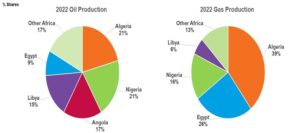
Fossil fuels—oil, gas, and coal – accounted for nearly 90% of primary energy consumption in Africa in comparison to 82% worldwide in 2022. This is understandably so, because Africa is endowed with large liguids petroleum and natural gas resources and the continent produced over 7% of global crudfe oil and 6% of natrual gas production. Of course, according to EI (2023), Nigeria accounted for the majority of oil and gas production in Africa in 2023 (See EI 2023 Chart 2). There are concerns, however, as to whether Afica can sustain its oil and gas production with the evolving energy landscape favoring renewable energy sources.
In fact, according to EI Statistical Review of World Energy 2023, “whilst global oil production has increased at an average annual rate of around 1% over the past 10 years, Africa’s output has been declining at around 2.7% (just under 3%) per annum. Nigeria’s oil production has declined at around 5% per annum of over the same period, exceeded by only that of Equatorial Guinea (-9.4%), Tunisia (-6%) and Sudan (-5%). The average annual growth in gas production over the past 10 years in Africa has been consistent with global production growth at around 2%. However, Nigeria’s production has only grown at around 0.3% over that same period and witnessed a drop of 10.6% (~5BCM, the single largest drop of any African nation) in 2022 versus 2021.”
Energy Institute Statistical Review of World Energy 2023
The decline in oil production, over the last decade in Africa, especially in Nigeria, is explainable in terms of regulatory and industry reform uncertainty. The reform journey took too long, spanning over 20 years apart from rising insecurity of assets and the rising call for defunding petroleum development to facilate easy renewable energy transition. To the extent that natural gas was intially considered unfit as a glabal transitioning fuel. When the dust settles, the outlook for oil and gas production expansion is optimistic because of PIA 2021 despite the avoidable hitches delimiting its impementation processes. The hitches in the implementation are not inevitable because they are driven mostly by politcal expediency, which are temporal. Thus, the output expansion objective, with the willingnes of the Federation to opt out of early rent extraction mechanism realisable. Using the more progressive fiscal instruments and terms to support a delay rent extraction mechanism based on progressive dual tax system makes the fiscal regime in Nigeria both attractive and competitive.
The emerging peteolum producers in Africa must, however, be made aware of the inescapability to reform and restructure the governance, acreage management, fiscal framework, and stakeholder management if petroleum value chain optimisation is to be achieved in Africa. When these reforms are put in place and the search by Africa Petroleum Producers’ Organisation (APPO) for in-house funding sources materialised, Africa oil and gas production shall rise again and perhaps for the expanding through put refineray capcity in Africa.
Perhaps, there is also room for improved funding for petroleum development with advances in technology to cut carbon emissions and the recommitment of prominent international oil companies to the black gold. The economic rent is too attractive to surrender when the possibility to cut emissions and expand production are non-mutually exclusive decisions. Although, the growth in carbon emissions measured as corbon dioxide equivalence, in Africa at 1% is above the world average growth of 0.7 per annum between 2012 and 2022, its share of emissions in 2022 is only 4.3%, which is the lowest among the worldwide energy regions.
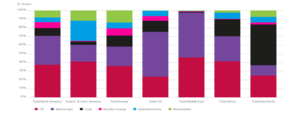
Additionally, it is interesting that the international petroleum companies also see renewable energy sources as global business opportunities. Africa must put renewables in its energy mix without necessarily abandoning the abundant liquid petroleums in the several frontier basins in Africa. As stated severally by energy specialists and analysts, energy resources landscape evolves, hardly fully transist for one to another, and to a large extent its sustainability depends on adaptability, acceptability and affordability. Some analysts even argued that the evolution of an emerging energy source can take several decades to replace the dominant energy resource in the fore. For example, the share of coal in primary global energy rose from 25 percent 2000 to a high of 30 percent in 2012 and declined from a high of 28% in 2022. Meanwhile, natrual gas christened as transition fuel or the future fuel rose from 20% to a high of 25% from 2000 to 2021 worlwide. Chart 3 from EI (2023) shows the regional consumpiton pattern of energy in 2022.
Energy Institute Statistical Review of World Energy 2023
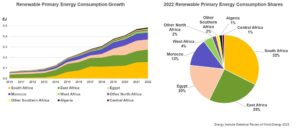
Renewable energy consumption is emerging as part of the energy mix in Africa. In 2012, renewable energy represented just 0.5% of Africa’s primary energy consumption and risen to ~2.5%. The comsumption growth rate of renewables average nearly 20% per annum and 1.5 times higher than the global average of 12.6%. The deployment of renewables is largely concentrated in Southern, East, and North Africa, accounting for 95% of renewable energy demand in Africa in 2022. West Africa is significantly lagging behind in the adaptability of renewables in its primary energy mix.
CONCLUDING REMARKS AND OBSERVATION
The 72nd Edition of Statistical Review of World Energy marks a new dawn as the management and proprietorship of the periodical shifts to the Energy Institute UK (EI) from the inaugural publisher, the British Petroleum (BP). Indeed, seventy-one previous editions of the BP Statistical Review of World Energy are uniquely incredible and valuable in academia, government, and industry circles.
It is not conjectural that the quality of information reported in the publication is highly dependent on the sources of the information, which perhaps makes information on energy in Africa, to some extent in comparison to other regions, very bare. Africa must step up to the plate to collect quality data and information on energy and energy resources for planning and administration.
Africa is energy poor, perhaps, not for lack of resources but because of low accessibility, availability and adaptability of secondary energy—electricity and petroleum products in particular. The per capita energy consumption in Africa in 2022 was 14.2 GJ, which is just about a quarter or a tenth of the per capita energy consumption in South and Central America and the Middle East, respectively, in 2022. While energy production is pronounced at creating elites in the society, energy consumption is critical for aggregate national quality of life enhancement, and productive sector expansion for sustainable economic growth. It is an established fact that energy consumption per capital and GDP per capital are highly correlated.
Africa must play in the drive for renewables in the evolving energy landscapes, without necessarily abandoning the abundant liquids petroleums in the several frontier basins in Africa. As stated severally by energy specialists and analysts, energy resources landscape evolves, and hardly fully transist from one to another, and to a large extent its sustainability depends on adaptability, acceptability and affordability. Some analysts even argued that the evolution of an emerging energy source can take several decades to replace the dominant energy resource in the fore.
Source: The ValueChain