
Petroleum Product Price Deregulation And Subsidy Removal In Nigeria
Petroleum Product Price Deregulation And Subsidy Removal In Nigeria
By Omowunmi Iledare, PhD (GNPC Professor & Chair in Petroleum Economics)
Preamble
In an environment where perfectly competitive petroleum downstream market exists, the inkling for price regulation or deregulation is an anomaly. However, if the downstream market is a natural monopoly in such environment, then, a significant regulatory effort is required to prevent market failures due to anti-competitive behaviors. Market failure in such a case reflects the inability of the market to allocate resources efficiently and perhaps equitably. Let me declare upfront that the Nigeria petroleum downstream sector is a hybrid system due, perhaps, to institutional barrier to entry.
Under the prevailing circumstances, the sector is neither operating under a perfectly competitive market structure nor in any form exhibiting a natural monopoly structure. However, the wholesale and retail segments of the downstream market in Nigeria consists of large sellers, which can be characterized as oligopoly in structure. On the other hand, the distribution ends appear to many to be pseudo monopolistic featuring very many small sellers appearing to be price takers with guaranteed margin plus illegal because of regulatory failures and perhaps, ineptitude governance of the sector over the years. Thus, to a large extent there is not exactly an economic model to appropriately define the market clearing price to ensure consumer surplus and producer surplus under a Pareto optimality conditions in the sector. The deviation is exacerbated because of the low refining capacity in Nigeria. Thereby creating a monopoly source of imported petroleum products in the more recent years, precisely, since 2015. Thus, the rationale for the following discourse on the need to decontrol petroleum product price and delegitimize unbudgeted petrol subsidies is premise on the apparent unintended consequences of the pricing mechanism adopted over the years in Nigeria. These glaring unintended consequences in my opinion include but not limited to, funding inadequacies for priority projects, crowding out investors in capital funding competition, and uncontrollable FOREX market. The paradox of petroleum subsidies arising from price control is evident in Charts 1 and 2.
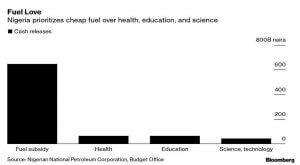
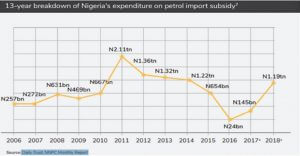
Chart I show the paradox of the Nigeria petroleum subsidies in 2019. Nigeria seems, over the year to prefer burning cheap fuel on debilitated road infrastructure to education health and science. The chart also portrays what ought not to be that has remained to be for years as evidence in Chart II. The aim of this Op-Ed is to attempt to explain the challenges and of course proffer conjectural solution to ameliorate the unintended consequences of price control and, perhaps, deregulatory apprehensions. As I mentioned earlier, price control or regulation is a legitimate intervention when the market system fails to promote efficiency, equity, and social responsibility. In the process, however, government intervention may become an albatross. Thus, when the costs of regulation overshoot the benefits to the extent as observed in Charts 1 and 2 above, something has to be done, and what ought to be done is price decontrol.
Price regulation through the use of coercive power of government and fear of social unrest is like riding on the back of the tiger. The end results are becoming to me quite catastrophic. It is plausible to argue that the prevailing high misery index in terms of the combination effects of high inflation, high unemployment, high exchange rate is statically correlated with regulatory failure in the petroleum downstream market in Nigeria. So, what is the way out of this catastrophic path, keeping in view the energy transition dynamics? Perhaps additional historical perspectives and comparative regional lessons might help Nigeria to get out of the lacuna created by the perpetual petroleum subsidy payments at the expense of so many desirable projects with posterity implications—good road infrastructure, enhanced energy infrastructure, education and expanded economic output. As I mentioned earlier crowding out investors from capital fund inhibits growth just as money supply continue to chase fewer goods. Countries like the United States and Venezuela, which for many years controlled the price of petroleum products offer great lesson for Nigeria not to continue along this path.
For the US, under Nixon in the 1970s, it was a disaster waiting to happen and it did happen until President Carter and President Reagan reversed the interventions. The opportunity costs of regulatory interventions may be difficult to estimate, but huge. For Nigeria, an honest assessment as reflected in Charts 1 and 2 tells the story of preferring cheap fuel to burn at the tail pipe and political survival because of the fear of social unrests to quality education and good roads. More recently too , Venezuela offers good lessons on what not to do with oil money—do not subsidize the consumption of an economic good for just a pleasurable style of life. Venezuela made the mistakes offering petroleum product at the cheapest possible rate and paid dearly for it. Of course, there are other factors that affected Venezuela Oil and Gas beyond income redistribution through petroleum subsidies. I have spoken about that a lot with respect to the governance of the oil and gas sector as it relates to the not signing to law the PIGB 2018.